segunda-feira, 30 de abril de 2012
Aprenda Earned Value em 10 minutos!!!
É claro que não é possível aprender Earned Value em apenas dez minutos, mas esse vídeo dá um excelente overview sobre o tema. Vale a pena!!!


Quando o cliente é seu chefe
Grupos internos, que podem ser tão sujeitos aos debilitantes efeitos da pressão por resultados quanto equipes que trabalham com clientes externos, também podem sair ganhando ao colocar stakeholders no barco. Já se o cliente da equipe for seu chefe, é preciso pensar de um jeito um pouco distinto sobre a natureza dessa participação. Se procurar o chefe com muita frequência, o risco é ser visto como alguém "necessitado", o que incitaria a microgestão. Para não dar essa impressão, seria bom definir expressamente as expectativas desde o início.
Um alto pesquisador de uma fabricante de bens de consumo sugere a seguinte abordagem, bem sábia: diga ao chefe "Você disse que esse projeto é vital para você, para nós e para a organização. Nossa equipe quer ter certeza de que está levando em conta todos os matizes, o que significa que vamos precisar ouvir com frequência sua opinião. Que tal agendarmos sessões regulares de resolução de problemas para ficarmos bem alinhados?"
Essa tática tem vários méritos:
- Integra o contato frequente com o chefe ao plano do projeto, impedindo que a equipe perca de vista suas necessidades
- Evitar criar a impressão de que os membros da equipe só procurar o chefe quando não conseguem achar uma solução
- Posiciona o tempo juntos como um exercício em resolução conjunta de problemas, o que deixa claro que o chefe divide a responsabilidade pelo sucesso do projeto. Isso, por sua vez, reduz a pressão sobre a equipe, que já não se sente trabalhando num vácuo, temendo o dia em que seu trabalho será julgado.
Fonte: Artigo publicado na Harvard Business Review Brasil, edição Abril 2012, pág. 49
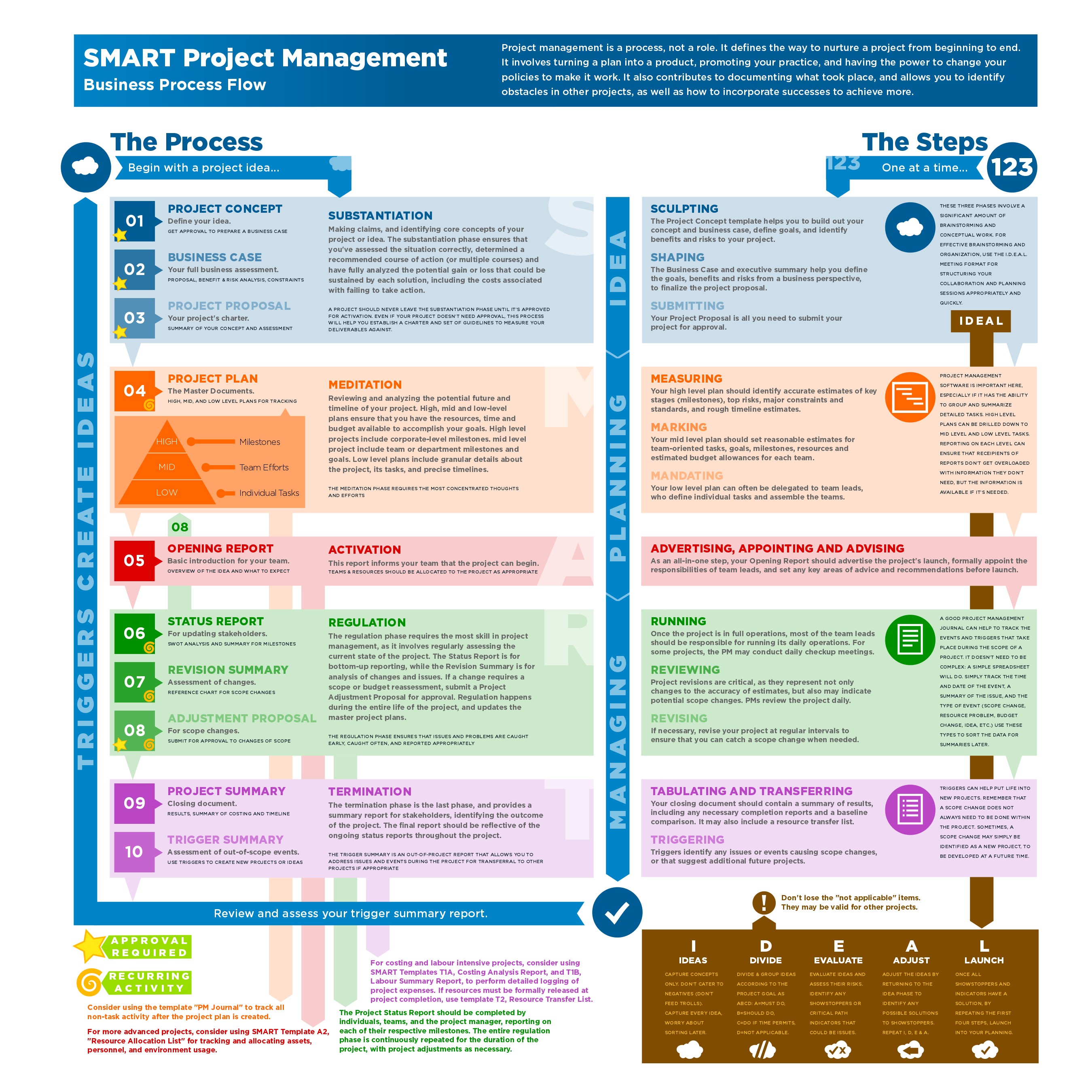
SMART Project Management - Business Process Flow
A visualização no blog não é das melhores, mas vale a pena salvar a imagem no seu computador e estudar esse fluxo a fundo.

Fonte: http://stevepye.me/wp-content/uploads/2011/09/SMART-Lite-Process.jpg
Assess People Skills in Project Managers
The best
project leaders don’t just manage projects. They manage people, too. So how can
companies spot candidates with the necessary soft skills?
Project professionals cannot live on tactical competencies
alone. But sound people skills aren’t as easy to spot in a candidate as the
ability to deliver a project on budget. So what can organizations do to ensure
the applicant has what it takes?
For starters, hiring managers must understand the value of
people skills, says Ginger Levin, DPA, PMP, PgMP, OPM3® certified professional,
a project management consultant and educator based in Lighthouse Point,
Florida, USA.
“Ninety percent of a project manager’s time is spent
communicating with stakeholders. He or she is the leader on the project and
coordinates work performed by project team members, the technical experts,”
says Dr. Levin, also author of Interpersonal Skills for Portfolio, Program and
Project Managers.
Deborah H. Herting, PMP, a Doylestown, Pennsylvania,
USA-based author of The Power of Interpersonal Skills in Project Management,
says organizations should look for candidates with the ability to:
- Communicate project goals cross functionally and with all levels of the organization.
- Unite project stakeholders through collaboration and teamwork.
- Gain project buy-in with active listening and relationship-building.
Identifying people skills in project professionals isn’t
difficult — you just have to know what to look for.
On a résumé, for example, look for candidates with elected
leadership positions, public speaking awards, community service, participation
in team sports, and sales and/or management experience, suggests John Paul
Engel, a Sioux City, Iowa, USA-based author of Project Be the Change: Career
& Academic Advice from Highly Successful People. These experiences indicate
interpersonal skills such as communication, leadership, empathy and teamwork,
he says.
Once a candidate has advanced to the interview stage, use
the “STAR” method to establish patterns of behavior that demonstrate people
skills, suggests Gillian Ormston, an executive coach at Intelligent Awakenings,
a project management coaching firm in Luton, England.
Ask open-ended questions that encourage candidates to
describe real-life “situations,” including the “tasks” they were working
toward, what “actions” they took to achieve it and what the “results” were.
“Through using some targeted questions, interviewers can
understand a candidate’s pattern of behavior and gain a clear feel for their
people skills,” Ms. Ormston says.
Stephen Balzac, president of 7 Steps Ahead, a management
consulting firm in Stow, Massachusetts, USA says the following questions are
good examples of questions that will show evidence of people skills in action:
- When your team had a difficult decision to make, what did you do to help the team reach consensus?
- When someone on your project team made a mistake, what did you tell your own manager?
- When someone on your team pointed out that you were wrong, how did you respond?
Pay attention to whether the candidate speaks inclusively
about how he worked with his team, or whether he was always in conflict with
the team, says Mr. Balzac.
Answers that show the candidate’s ability to persuade others
rather than compel or intimidate them demonstrate positive communication. And
responses that show a willingness to focus on understanding why a problem
occurred and how to fix it, rather than finding someone to blame, indicate good
leadership.
Candidates who ask engaging questions about the company and
position, turning the “interview” into more of a “dialogue,” demonstrate strong
listening skills, adds Dr. Levin.
And sometimes, actions speak louder than words — especially
in an interview. Look for candidates who smile, maintain eye contact and sit on
the edge of their seat. All of these non-verbal cues indicate a high level of
interpersonal engagement, says Mr. Engel.
At the end of the day, a well-rounded project manager is the
best project manager, so use these tips to find one with both technical and
personal prowess.
Fonte: publicado no site do PMI: http://www.pmi.org/Professional-Development/Career-Central/Assess-People-Skills-in-Project-Managers.aspx
Assinar:
Postagens (Atom)